One inverter per panel. Independent MPPT. No shading losses. No single point of failure. Hoymiles micro inverters give every solar panel on your rooftop its best possible output — every hour of the day.
97.0%
Max Efficiency
HMS Series
IP67
Weatherproof
Monsoon-tested
15 Yr
Warranty
HMS Series
Per Panel
MPPT
Individual tracking
01
Each Hoymiles micro inverter mounts directly behind one solar panel (or two panels for dual-input models). DC electricity from that panel converts to 230 V AC right at the source — no high-voltage DC runs across your roof.
02
Every micro inverter runs its own Maximum Power Point Tracking algorithm. If a water tank casts a shadow on two panels at 11 AM, those two panels underperform — but all other panels continue at 100%. String inverters can't do this.
03
All micro inverters connect to a shared AC bus — the same wiring as your home's distribution board. The total AC output feeds your loads and excess exports through net metering. One DTU gateway monitors every unit in real time.
ಕನ್ನಡದಲ್ಲಿ ವಿವರಣೆ — Hoymiles ಮೈಕ್ರೋ ಇನ್ವರ್ಟರ್ ಹೇಗೆ ಕೆಲಸ ಮಾಡುತ್ತದೆ, ಅದರ ಪ್ರಯೋಜನಗಳು, ಮತ್ತು ಭಾರತೀಯ ಮನೆಗಳಿಗೆ ಏಕೆ ಸೂಕ್ತ.
Shade on one panel does not drag down the rest of your system. Each panel runs at its own maximum regardless of what its neighbours are doing.
See real-time output from every single panel via the S-Miles Cloud app. Know exactly which panel is underperforming, when, and by how much.
If one micro inverter fails, the other 10 keep running. With a string inverter, one failure stops your entire system.
East and west-facing panels, flat and sloped sections — each runs at its own MPPT. A string inverter would force them to compromise.
Adding capacity is as simple as adding a panel and a micro inverter. No string recalculation, no inverter replacement, no disruption to what's already installed.
DC wiring stays short — from panel to the micro inverter directly behind it. No high-voltage DC cable runs across your roof, reducing fire risk and installation complexity.
| Feature | String Inverter | Micro Inverter (Hoymiles) |
|---|---|---|
| Per-panel MPPT | ✗ String-level only | ✓ Every panel |
| Shading resilience | Whole string drops | Only affected panel drops |
| Mixed orientations | Compromised yield | Full yield on each face |
| Monitoring granularity | System total only | Per-panel, real-time |
| Single point of failure | Yes — system stops | No — others keep running |
| Phase expansion | String redesign needed | Add panel + unit anytime |
| DC wiring length | Long DC runs on roof | Short run, panel to unit |
| Warranty | 5–10 years typical | 12–15 years (Hoymiles) |
| Best for | Unshaded, single orientation | Shading, mixed roof, expansion |
TSUN GEN3 micro inverters use a trunk cable T-connector AC bus — a daisy-chain wiring method that eliminates long individual cable runs across your rooftop and makes expansion plug-and-play simple.
Protective Cap
Seals the open end of the trunk cable at the last unit in a branch. Keeps the AC bus weatherproof at IP67 standard when no further units are connected.
T Connectors
Each micro inverter ships with a 0.5 m AC cable ending in a T-connector that plugs directly into the trunk cable. No junction boxes, no exposed terminals — just click in and the unit joins the AC bus.
Trunk Cable
A continuous AC bus cable (10–12 AWG) that runs along the panel row. All micro inverters tap into it via their T connectors. One cable carries the combined output of all units on that branch to the distribution board.
Male / Female Connectors
Trunk cable segments use keyed male/female MC4-style AC connectors. Extending the system means adding a new cable segment — no rewiring of existing units.
1 × 3 kW + 1 × 1 kW
8 panels · 4 micro inverters
Two branches on the same rooftop — a 6-panel branch running a 3 kW trunk cable, and a separate 2-panel branch on a 1 kW trunk. Ideal when panels face different orientations or are physically separated.
3 × 2 kW
12 panels · 6 micro inverters
Three parallel branches of 4 panels each, all feeding the same distribution board. Keeps each branch within comfortable cable current limits and allows independent expansion of any row.
Start small, grow anytime
Begin with 4 panels and 2 micro inverters. Cap the trunk end. When ready, remove the cap, clip in a new cable segment, and add more units — no disruption to what's already running.
Maximum Units Per Branch
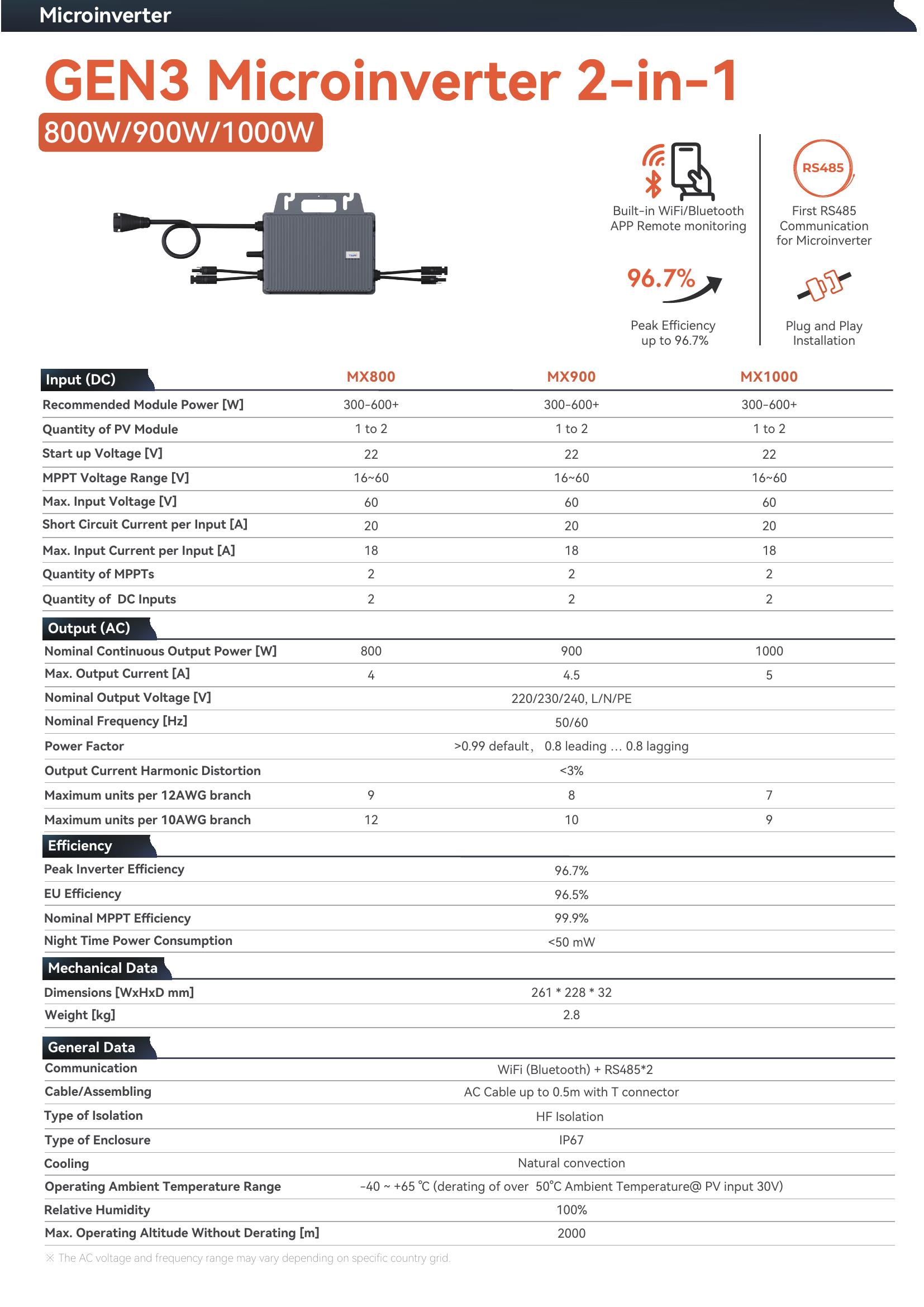
A single trunk cable branch supports 9–12 micro inverter units depending on cable gauge: up to 12 units on 10 AWG, up to 9 units on 12 AWG. Beyond this, start a new branch. Techedge engineers design branch layouts to stay within safe current ratings before installation.
Most-specified Hoymiles micro inverters for residential rooftops in Bengaluru.
600 W output · 96.7% eff.
₹5,800
+ 12% GST
800 W output · 96.7% eff.
₹6,800
+ 12% GST
800 W output · 97% eff.
₹7,500
+ 12% GST
1000 W output · 97% eff.
₹9,000
+ 12% GST
BIS India certified, built-in WiFi + Bluetooth + RS485, no separate gateway needed. 15-year warranty. Trunk cable T-connector system for clean rooftop wiring.
800 W output · 96.7% eff.
₹6,500
+ 12% GST
900 W output · 96.7% eff.
₹7,200
+ 12% GST
1000 W output · 96.7% eff.
₹7,800
+ 12% GST
Good fit ✓
String inverter may be better ↗
A micro inverter is a small inverter that mounts directly behind each solar panel and converts that panel's DC output to AC independently. Unlike a string inverter — where all panels connect to one central unit — micro inverters give every panel its own Maximum Power Point Tracking (MPPT). This means shading or soiling on one panel has no effect on the others.
Micro inverter systems typically cost 15–25% more than equivalent string inverter systems in upfront hardware cost. However, in shaded or multi-orientation rooftops, micro inverters can deliver 10–20% more annual yield — making the payback period comparable or better. For unshaded single-orientation rooftops, a string inverter is usually the more cost-efficient choice.
For most 2-panel groupings in residential use, the HM-600 or HM-800 covers 300–400 Wp panels. For premium systems with 15-year warranty, choose the HMS series. Techedge engineers will recommend the right model based on your panel wattage, roof layout, and budget.
Hoymiles micro inverters are compatible with standard crystalline silicon solar panels (mono and poly). For best results, each PV input channel should be matched to a panel within the inverter's rated input range (typically 250–600 V Voc). Techedge sizes the pairing as part of system design.
Hoymiles uses a DTU (Data Transfer Unit) gateway that collects data from all micro inverters via power-line communication. The DTU connects to your Wi-Fi router and uploads to the S-Miles Cloud platform, accessible as a web app and mobile app. You can see real-time watts, daily generation, and lifetime output per panel — plus receive fault alerts per unit.
Yes — this is one of its biggest advantages. Adding capacity is straightforward: add a solar panel, add a Hoymiles micro inverter, connect to the AC bus. No string recalculation, no inverter replacement, no impact on existing units. You can grow from 2 kW to 6 kW over three years without redesigning anything.
Hoymiles micro inverters meet IEC 62109-1/2 standards and comply with Indian grid interconnection requirements at 230 V / 50 Hz. Techedge handles all net metering documentation, DISCOM approvals, and commissioning as part of a full EPC installation.
Our engineers assess your rooftop, shade pattern, and load — then recommend the right system: micro inverter, string, or hybrid. Fixed quote. No surprises.