
Across the world, 775 million people have no access to electricity. For most, darkness after sunset means kerosene lamps — and all that comes with them: indoor air pollution, fire risk, and a monthly fuel expense that households earning ₹8,000–₹12,000 cannot afford to stop paying.
Another billion live on grids that cut out for 6–12 hours a day. A grid connection on paper is not the same as light when you need it.
Solar home lighting systems are changing this — not slowly, through decades of infrastructure planning, but now, panel by panel, household by household.
What This Looks Like on the Ground
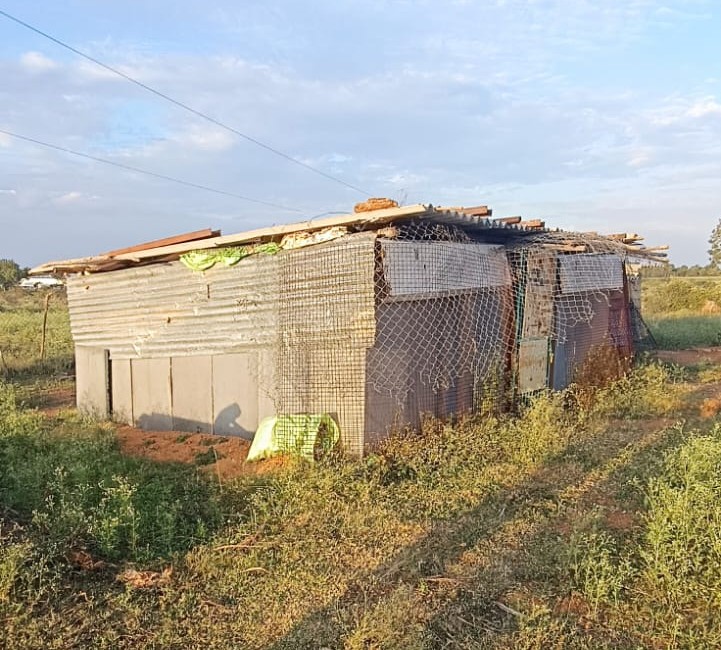

This is what energy poverty looks like in India — not always an absence of wires, but an absence of reliable power. A goshala, a farming family’s home, a temple. All present in the official electrification maps. All dark after six.
For families in these conditions, the costs are immediate:
- Children study under kerosene flames that cause respiratory damage
- Women cook in kitchens where indoor air pollution from kerosene rivals tobacco smoke
- Mobile phones — increasingly essential for banking, markets, and emergency services — go uncharged or require paid trips to a charging shop
- Livestock facilities run night duties by phone torch or not at all
The same reality plays out in sub-Saharan Africa (600M+ without electricity), Bangladesh, Myanmar, Nepal, Indonesia, the Pacific Islands, and parts of Latin America. The geography changes. The problem does not.
What Solar Home Lighting Systems Are
Not every off-grid community needs a rooftop installation or a grid connection. What they need first is light — safe, reliable, affordable — and the technology for that is already proven.
🔦 Solar Lantern
Pico Solar — Tier 1
Single LED light + phone charging. Replaces a kerosene lamp. Portable, no installation required, immediate use.
₹800–₹2,000
🏠 Solar Home Kit
Home System — Tier 2–3
2–4 LED lights + fan + phone charging. Panel, battery, controller. Powers 1–3 rooms for 8–10 hours overnight.
₹5,000–₹18,000
⚡ Off-Grid System
Full Home — Tier 4–5
Whole house — lights, fan, TV, fridge, pump. Inverter, battery bank, and a larger panel array.
₹40,000–₹2,00,000+
The GOGLA/Lighting Global Tier system classifies off-grid solar from Tier 0 (basic lantern) to Tier 5 (full household power). For most families without electricity, Tier 2–3 home kits are the right entry point — enough for study lighting, safe cooking visibility, phone charging, and a fan.
How Distribution Reaches the Last Mile
The panel is not the hardest part. Getting it to a family in a remote village — with the right sizing, working correctly, with the user knowing how to operate and maintain it — that is where most programs fail or succeed.
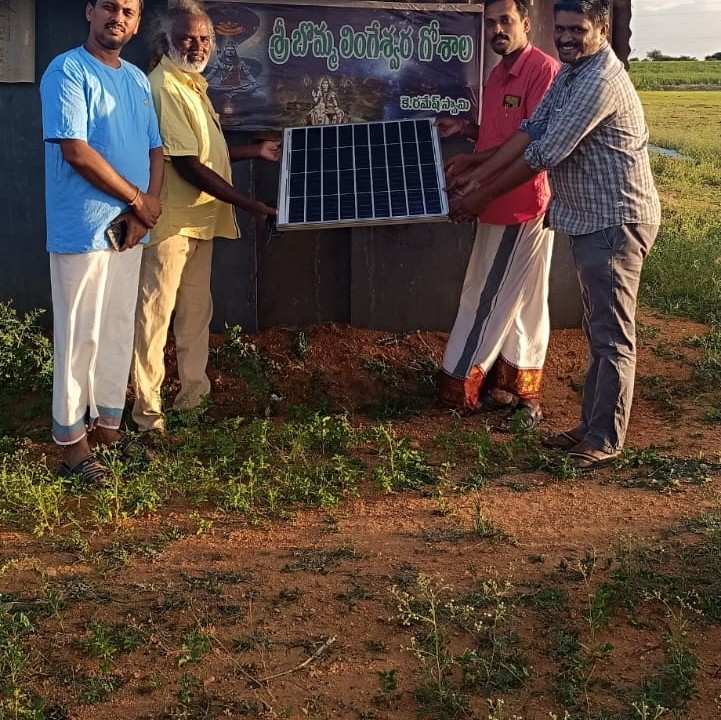
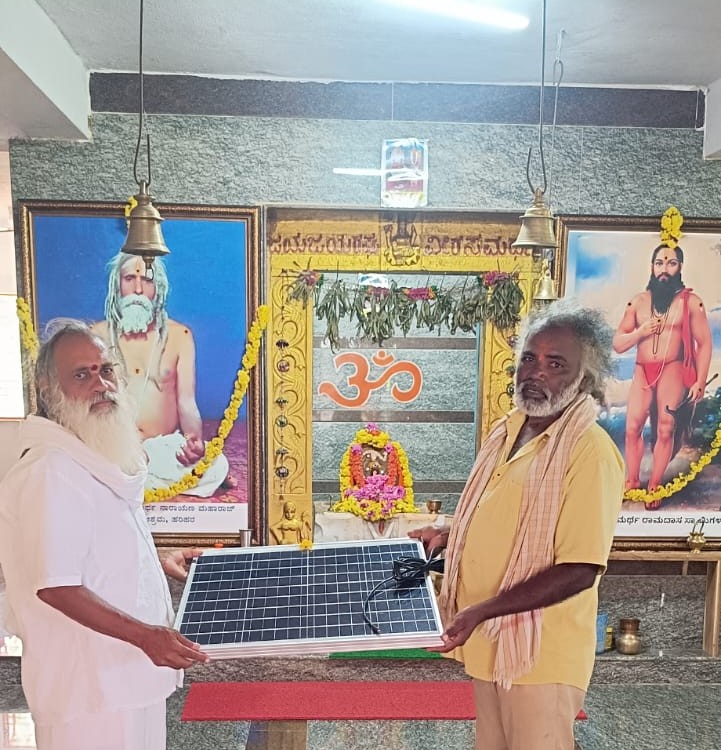
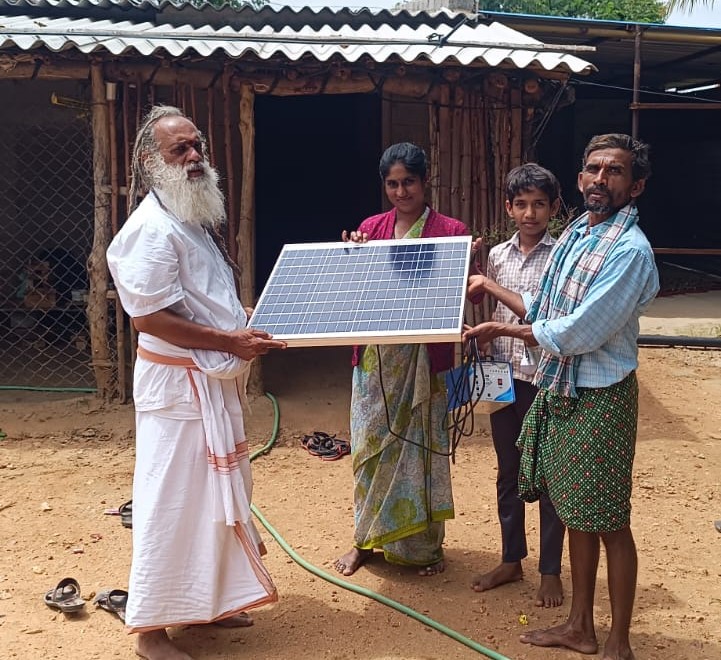
Last-mile solar distribution works when it is carried out by people who already have the trust of the community. In India, that often means religious organisations, local trusts, and Swami-led initiatives. Sri Rama Rajanna Swamy Ji’s program at Sri Bhomma Lingeswara Goshala is one example — distributing solar home lighting systems directly to families and institutions in villages where the grid is unreliable or absent.
Globally, this last-mile distribution challenge is solved in different ways:
- Kenya and Tanzania: M-KOPA’s PAYGO model finances panels through mobile money — 10M+ households reached
- Bangladesh: IDCOL programme has deployed 6M+ solar home systems in rural areas
- Ethiopia and Nigeria: The largest off-grid solar markets in Africa, driven by NGO and government programs
- Myanmar, Cambodia, Indonesia: Island and remote communities where grid extension is decades away
- Pacific Islands: Fiji, Vanuatu, Papua New Guinea — diesel generation costs $0.80–$1.50/kWh; solar is financially transformative
The technology is the same. A panel, a battery controller, an LED fixture. What changes is who carries it to the doorstep.
Field Documentation
Who Runs These Programs
🕍 Religious Trusts & Ashrams
Deep community roots and grassroots reach. Ideal for village-level distribution with zero marketing overhead. Swami-led and temple trust programs have distributed thousands of panels across Andhra Pradesh, Telangana, Karnataka, and Tamil Nadu.
🤝 NGOs & Development Orgs
World Bank, USAID, GIZ, SELCO Foundation, Lighting Asia — programmes that need quality-certified supply at scale. International programs require IEC/BIS-certified products and traceable supply chains.
🏢 CSR Programs
Companies with CSR mandates under the Companies Act 2013 — solar home lighting qualifies under Schedule VII (environment, rural development). Bulk solar supply with CSR documentation is available.
🏛️ Government Schemes
PM-KUSUM, MNRE off-grid solar programme, state rural electrification boards — bulk procurement through GeM or direct tender. India's off-grid solar targets are among the largest in the world.
The Numbers That Make It Work
After payback, the family saves ₹600–₹1,200 every month for the remaining 4–7 year life of the system. For a family earning ₹8,000–₹12,000 a month, that is a 7–15% increase in effective income — from sunlight.
What Techedge Supplies
We supply solar panels, lanterns, and home kits for NGOs, religious trusts, CSR programs, and government bodies — at bulk pricing with proper supply documentation.
- Solar lanterns — pico solar for basic lighting and phone charging
- Solar home kits — 1–3 room systems with fan capability
- Bulk supply for programmes distributing 10 to 10,000 units
- Export documentation for international development programmes
Supply Solar for Your Program
Whether you are distributing 10 panels or 10,000 — to villages in Karnataka or communities in Kenya — we supply quality solar home lighting systems at bulk pricing with proper documentation.
NGO pricing available. CSR supply documentation supported. Export orders welcome.
Field photographs and video: Sri Bhomma Lingeswara Goshala solar distribution program, near the AP and Karnataka border, September 2025. Techedge supplied solar panels for this program.